
Adam Manning on the First Nations Artist Residency
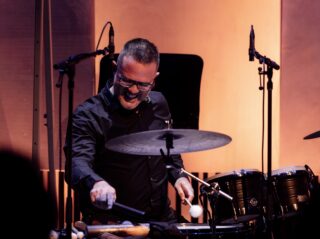
The First Nations Artist Residency (FNAR) program is an artistic and professional development initiative presented in partnership between the Melbourne International Jazz Festival (MIJF), the Australian Art Orchestra (AAO) and Songlines Music Aboriginal Corporation. The program supports the career development of a First Nations musician with a practice in jazz, improvisation, singer-songwriter music, hip-hop, soul, or contemporary art music and its composition.
For MIJF 2025, composer, percussionist, painter, educator and proud Kamilaroi man Adam Manning brought First Rhythms to life as part of his role as FNAR program leader 2024-25. First Rhythms weaves traditional percussive language with modern instrumentation, visual art and a fluid interplay of improvisation and notation and is an evocative exploration of rhythm as a bridge between culture, Country and contemporary performance. Manning and his ensemble captivated the audience at the Primrose Potter Salon at the Melbourne Recital Centre, with a “transformative, a deeply moving deliberation on rhythmic pulse as a container of memory and culture” (Des Cowley, Australian Book Review).
As EOIs open for the 2026-27 FNAR, we caught up with Adam about his experience across his residency and advice for any First Nations musicians seeking to apply for the program.
What drew you first to the FNAR program and what made the FNAR a timely opportunity for you at the stage you were at in your practice/career?
AM: At that point in my practice, I was still relatively new to composing, and I was looking for opportunities to develop that side of my artistry in a meaningful way with inspiring musicians. The residency offered a rare chance to do that within a supportive, and professional environment.
What does jazz mean to you and how has that potentially changed through taking part in the program?
AM: Jazz, to me, has always meant freedom – freedom to explore. For example, Improvisation, Western notation, and non-traditional forms like visual artworks were all given equal footing, when working with the AAO, which I loved.
Did you learn anything about yourself as an artist through the residency?
AM: The residency reinforced that my practice is deeply connected to people – listening, responding.
What surprised you most about the experience? Was there an idea or direction you were able to pursue through the residency that might not have been possible otherwise?
AM: What surprised me most was the level of support and trust from the Festival and the AAO. I hadn’t experienced that kind of support and creative freedom before. It allowed me to pursue ideas without hesitation or limitation.
Was there a particular moment during the residency that stands out for you now?
AM: Performing at the Melbourne Recital Centre with the AAO stands out as a defining moment. Being in that space, sharing the music we had developed, and feeling the energy of the audience brought everything together.
For someone who hasn’t heard of this program before, how would you describe it?
AM: I’d describe it as a deeply supportive and creatively open residency that gives First Nations artists the space, resources, and collaborators to develop and present new work that are not just about the outcome, but about the process.
What would you say to someone who’s on the fence about applying?
AM: I’d say go for it. Opportunities like this don’t come around often, especially ones that offer this level of support and trust in your voice.
Applications are open now for the 2026-27 First Nations Artist Residency program, and close at 6pm AEST on Tuesday 19 May 2026. Click here to read more about the program and download the application pack.